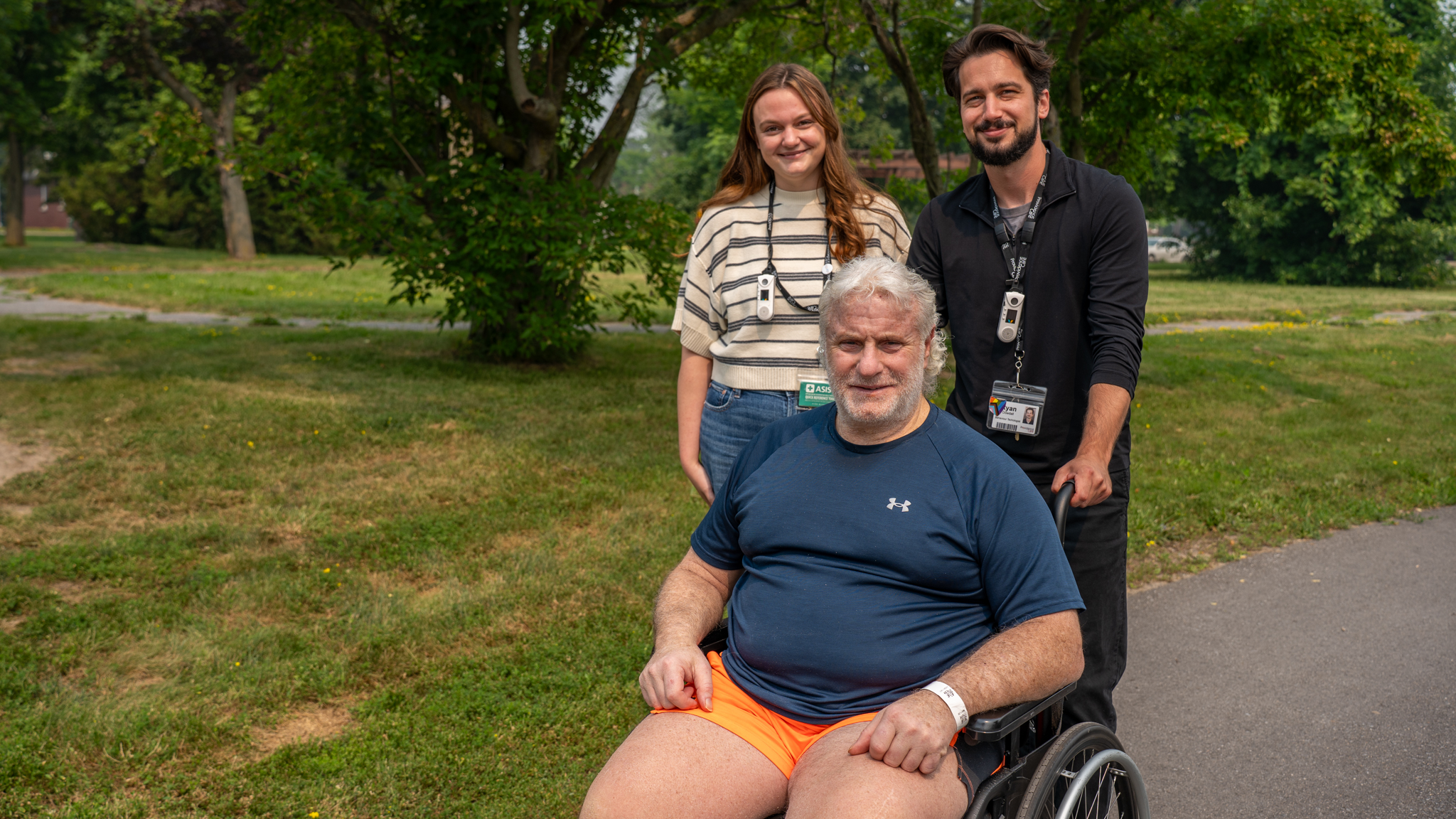
Dave Mullins is no stranger to hard work. He is a business owner, athlete, hockey coach, husband and father of four.
But over the last nine months, hard work and commitment have looked a lot different. This time, his determination has helped him through a long and challenging stroke rehabilitation journey with Providence Care.
“My whole mindset coming into this was that every day needed one success,” explains Dave. “Whether it was wiggling a toe, putting on a sock by myself or finally getting a fork from the plate to my mouth, I needed to find one success every day. And the other thing was, I wasn’t going to let it beat me.”

In the early hours of Dec. 2, 2025, Dave woke to find the entire right side of his body numb and tingling. By the time he arrived at Kingston Health Sciences Centre’s (KHSC) Kingston General Hospital site, he could no longer move his right arm or leg. He was told, at the age of 48, that he had had a stroke. It was the beginning of a long road to recovery.
“I essentially had to relearn how to walk, talk, eat and use my hand. But I just kept moving forward.”
After two weeks at Kingston General Hospital, Dave was transferred to Providence Care’s inpatient stroke rehabilitation unit.
When he arrived, Dave required intensive rehabilitation and focused on the smallest signs of progress to get him through.
“On Christmas Eve, I was lying in bed staring at my foot and my big toe moved just a little bit,” he recalls. “I called my wife like a four-year-old on Christmas Eve and said, ‘I wiggled my toe. I wiggled my toe!'”
For five weeks, Dave’s days were filled with physiotherapy, occupational therapy and speech-language therapy. The work was challenging and at times exhausting, but he credits his rehabilitation team with helping him see possibility when progress felt impossible.

“They pushed when they needed to push and they pulled me back when I needed to be pulled back,” he says. “The little things became huge things.”
Those small victories are at the heart of rehabilitation, says Director of Rehabilitation, Kara Asselstine.
“Every person’s recovery journey is different,” says Kara. “That’s why our teams work closely with patients and families to build individualized care plans that reflect their own goals and priorities.”
By January 22, 2026, Dave was discharged from his inpatient stay and began rehabilitation in Providence Care’s Outpatient Stroke Rehabilitation Program the very same day.
“I literally left inpatient in the morning and started outpatient in the afternoon,” says Dave. “I still had goals I wanted to reach, and outpatient gave me the chance to keep working toward them.”

Over the next several months, Dave attended outpatient rehabilitation four days a week.
By April 2026, Dave was nearing the end of his 12-week outpatient rehabilitation program and looking ahead to what life after rehabilitation might look like.
Then came another setback.
While helping open a new family food truck, Dave suddenly collapsed. Once again, the right side of his body was affected. Once again, he found himself in hospital, this time with the news he had had a second stroke.
Returning to Providence Care, Dave’s care team encouraged him to return to inpatient rehabilitation for more intensive therapy.
“I knew where I was in December and I knew how far I’d come,” says Dave. “I didn’t want to go back [to inpatient care]. But my rehabilitation team and doctors believed there was more recovery ahead of me. Looking back now, they were right. I wouldn’t be walking without a walker if they hadn’t encouraged me to come back.”
Back at Providence Care Hospital as an inpatient, Dave was discouraged, but once again dug deep and got back to work.
“I just looked at recovery like I would hockey development. I’d break it down. What’s the weakness? What’s the next step? Then I’d focus on that until it got better.”
Weeks of inpatient therapy in the spring once again turned into weeks of outpatient therapy in the Outpatient Stroke Rehabilitation Program. This time, Dave’s outpatient therapy was strategically tailored to the goals that mattered most to him, from coaching hockey to working in his family’s food trucks.
“I worked with a student occupational therapist who incorporated a hockey stick into therapy to work on balance and movement. I also was having a hard time with the strength and dexterity in my right hand, so I worked with the right people to make it so I could put on a barbeque at the hospital as a thank you to the entire staff on the unit where I had stayed.”

Wanting to give back, Dave and his wife Elisa helped organize a barbecue for the entire inpatient rehabilitation unit, Lakeview 1. Everyone who had played a role in his recovery was invited, from environmental services staff, nurses, physicians, to allied staff, nutrition staff and support team members. Working the grill, handling tongs and preparing the food became a part of his occupational therapy. A thank you from Dave that also helped his wellness and recovery journey.
“What makes rehabilitation so rewarding is being able to tailor therapy to each person’s goals,” says Kara. “Our teams are committed to individualized care, thinking creatively and finding meaningful ways to help patients regain the skills they need to return to the activities, relationships and roles that are most important to them.”
“There aren’t enough words to thank everyone who helped us through this,” says Dave. “On behalf of my family, we’re just so grateful to every member of the team. They supported us through the hardest days, celebrated the small wins with us and never stopped believing in me.”
It’s been nine months since Dave’s first stroke. In that time, he’s faced setbacks, celebrated hard-won victories and done plenty of tough slugging, putting in countless hours of rehabilitation both in the gym and at home.


On Aug. 26, he completed Providence Care’s Outpatient Stroke Rehabilitation Program, marking the end of a chapter that tested him physically, mentally and emotionally.
Next on the horizon is surgery to close the hole in his heart that physicians believe led to both strokes. While there is still work ahead, Dave has already checked off one of the goals that helped fuel his recovery.
For the first time since his stroke, Dave laced up his skates and returned to the ice.
“I was nervous, but it felt great,” he says.
It’s not a full return to hockey just yet. For now, the goal is to continue building strength, get more ice time and work his way back to coaching. But after everything he has overcome, Dave knows how to get there.
One small success at a time.